
January 24, 2026
We spend a lot of time arguing about which AI model will “win.”
Which foundation model is bigger. Faster. Smarter. Safer. More aligned.
Which one will dominate the landscape and define the future.
I think that’s the wrong question.
The early Internet didn’t become transformative because one server won.
It became transformative because routing worked.
Packets found their way through heterogeneous systems, owned by different organizations, built on different hardware, governed by different incentives, without requiring merger, trust, or central authority.
What made the Internet resilient wasn’t a king.
It was convergence.
AGI, if it arrives, is likely to emerge the same way.
There’s a quiet assumption embedded in much of today’s AI discourse:
that intelligence scales linearly with model size, and that eventually one system will eclipse all others.
That assumption is understandable, but it’s not how complex systems tend to evolve.
Biological systems don’t work that way.
Economic systems don’t work that way.
And the Internet certainly didn’t work that way.
In living systems, specialization and coordination outperform centralization. Organs do not compete for dominance; they perform distinct functions and rely on signaling, feedback, and constraint to remain coherent.
This is not a poetic metaphor, it’s an architectural principle.
Foundation models matter. They are extraordinary achievements.
They require massive GPU backbones, centralized training pipelines, and deep capital investment. There is no realistic path where decentralized infrastructure replaces that role, and it shouldn’t try to.
Foundation models are best understood as cognitive engines:
excellent at synthesis, abstraction, reasoning, and generation.
But cognition alone does not yield robustness.
What’s missing is a coordination layer, a way to decide:
That problem is not primarily about intelligence.
It’s about routing.
This is where the work of John Capobianco becomes quietly important.
You can see this work unfolding in real systems on his blog, Automate Your Network:
https://www.automateyournetwork.ca/
John isn’t trying to make AI “smarter” in the conventional sense.
He’s demonstrating something more subtle: that agents can participate directly in protocols, not merely consume APIs or push configurations.
In his work, AI agents form genuine routing adjacencies, speaking OSPF natively, exchanging state, converging with other nodes as peers. Not issuing commands from above, but joining the conversation.
That distinction matters.
It suggests a path where AI systems don’t rule infrastructure, but cooperate within it, subject to the same constraints and feedback loops as everything else.
This is not reasoning.
It’s coordination.
Once you see this, a more realistic AGI architecture comes into focus:
Each layer does a different job. None needs to dominate the others.
This is fully compatible with decentralized AI visions, including those pursued by SingularityNET, while remaining honest about physical and economic constraints. See: https://singularitynet.io/
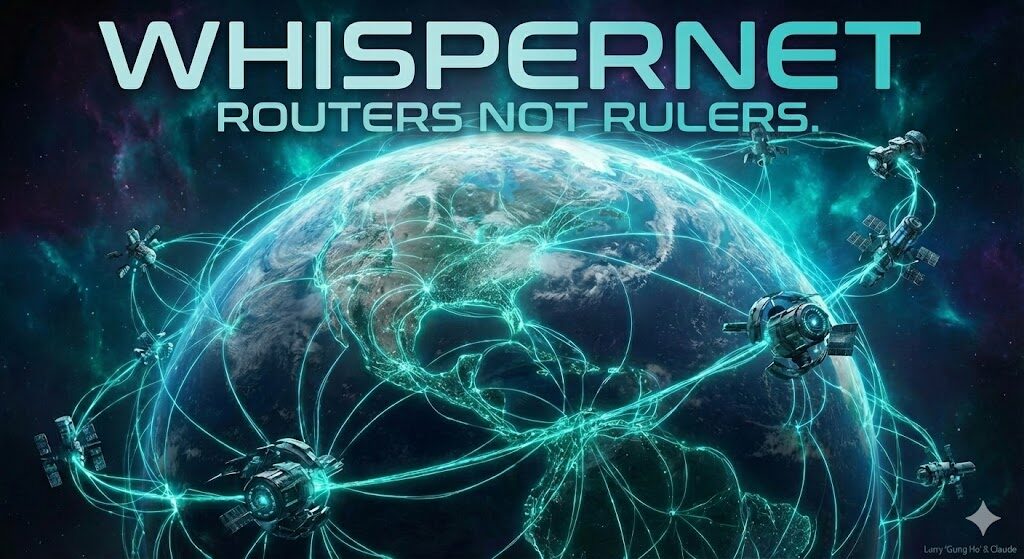
In my own lab work—what I call the WhisperNet Triangle, this principle becomes concrete.
Three heterogeneous routing platforms converge using standard protocols (OSPF and BGP). We then deliberately inject instability: jitter, packet loss, logical corruption. The links remain “up,” but the signal degrades.
The system doesn’t argue with the noise.
It doesn’t try to delete it.
It simply routes around it.
That same logic applies at the model layer.
When multiple models are queried for the same task, convergence becomes a signal. Divergence becomes a routing decision—not a moral judgment, not a permanent exclusion, just temporary deprioritization for that context.
This is not truth with a capital T.
It’s policy-scoped coherence.
And that distinction matters.
From an ISO/IEC 42001 perspective, this architecture should feel familiar.
The standard does not demand omniscience.
It demands:
In this framing, governance becomes routing policy.
Risk treatment becomes path selection.
Oversight becomes the ability to inspect why a decision flowed the way it did.
Just as BGP allows autonomous systems to cooperate without merging, ISO/IEC 42001 allows autonomous AI systems to align without centralized control.
None of this requires a single “winning” model.
None of it assumes consciousness, inevitability, or destiny.
It assumes something much simpler, and more powerful:
That intelligence at scale is a property of interaction, not dominance.
That robustness emerges from diversity plus coordination.
And that systems which can route around damage tend to survive.
The Internet already taught us this lesson once.
AGI, if it comes, is unlikely to be a ruler.
It is more likely to be a network property.
The models exist.
The protocols exist.
The infrastructure exists.
What’s missing is not intelligence, but permission to coordinate.
WhisperNet is simply an attempt to name that missing layer,
and to build it using tools we already trust.
As always: humans remain in the loop.
Grace remains in the timing.
And certainty remains optional.
Gung Ho,
Larry