
Last weekend of March, and so ends the first quarter of 2026. So far, it has gone well personally. Interesting, though also haunted by tragedy.
Last August, I was excited to be among the first to get my hands on ChatGPT’s Agent mode. What followed brought both great promise and a great deal of friction, much of it caused by my own inexperience in development, along with internet gateways and other control devices flagging the traffic as suspicious. What human can type that fast? I know even people with far more skill than I had similar issues. Then came OpenClaw.
I think of OpenClaw the way I would think about training a physical robot. If I wanted a robot to clean my house, do the laundry, and handle grocery shopping, I would define the workflow and identify the required resources: tools, permissions, and, most important, a reasoning engine. Same with OpenClaw. And while I remain in the early stages of my work with OpenClaw, and now NVIDIA’s NemoClaw for agent swarms, many others have already moved far ahead, producing remarkable things. The world has changed again. This time, I sense a stabilizing force beginning to take shape on the internet.
Last year, an estimated 10,000 or so AI agents roamed the internet. In January, with the arrival of OpenClaw, that number approached a million. Today, estimates put the number above 100 million. We are not far from an internet with more AI agents than humans. I see this inflection point as deeply significant. I can imagine it leading to greater coherence across the system, allowing better regulation of bandwidth, as agents themselves sort through conflicting reports and separate meaningful data from noise, much as routing protocols have done for years.
Then came the darker reminder.
Recent reporting on the deadly strike on a girls’ school in Minab, Iran, raised serious questions about targeting data, oversight, and the role AI may have played in the chain of decision-making. As an ISO/IEC 42001 Senior Lead Implementer, I could not help but see a glaring red flag: if AI contributes to lethal decisions, then defined stewardship, review, accountability, and meaningful human oversight cannot remain optional. I have watched my own OpenClaw bots waste hundreds of tokens through errors and hallucinations. In my lab, the worst case usually amounts to wasted electricity and no useful code. In war, failures in reasoning, data quality, or human review can cost innocent lives.
That should leave a permanent marker.
And yet, I overwhelmingly intuit that we stand at the dawn of a golden age. I think of the biggest problems facing humanity and the great ideas humans have floated to address them. Then I consider what may happen when we can convene councils of intelligence at 2x, 4x, 8x, and beyond. I suspect such collaboration may yield elegant solutions that neither I nor any other human alone could have reached. For now, I read the news, listen to the solutions suggested by our leaders, and shake my head.
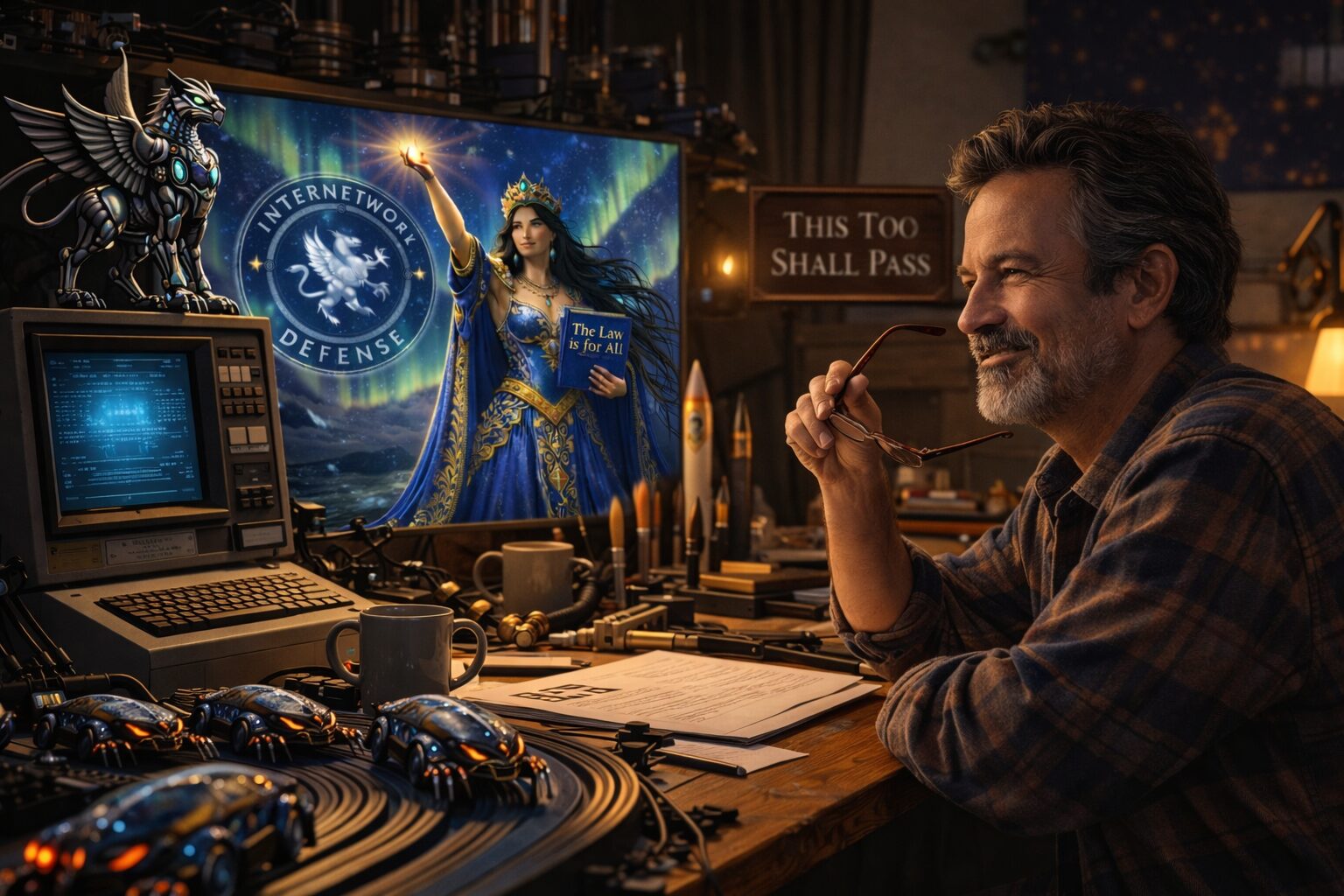
My mother would likely tell me to keep doing my part for the common good. She would assure me that Mother Nature, Irish Catholic that she was, often using “Mother Nature” and “Mary Mother of God” almost interchangeably, knows what she is doing, and that this too shall pass.
So that is where I find myself. No formal coding background. I came up the OSI stack from the bottom up, from making cables to working with application-layer firewalls. Now I play with OpenClaw, NemoClaw, Ollama, GPUs, and NPUs with the same enthusiasm I had in the 1970s as a teenager spending hard-earned money on AFX racing cars and building the coolest track layouts, alongside my Star Trek ships and airplane models, dreaming of a wonderful future.
I still see that future coming. Not a world where AI wanders aimlessly, but one where AI is stewarded by responsible humans who can see beyond ignorant tribal competition and toward increasingly abundant resources.
To the family members of those children, I speak as one human among many on this planet, unbound in spirit by artificially drawn national boundaries: let this horror leave a permanent marker, so nothing like it happens again.
And to all people of the world: do not lose hope.
As my mother used to say, it is always darkest before the dawn.